Best Time to Do Ha Giang Loop: Practical Travel Tips
| ExperiencesThe best time to do Ha Giang Loop is generally from March to April and from late September to November. These periods provide a favourable balance of comfortable temperatures, clearer mountain views and more manageable road conditions.
March and April are ideal for spring scenery, mild weather and outdoor exploration. Late September and October bring cooler temperatures, ripening rice fields and clearer views across the mountains. November is also attractive for its crisp air and seasonal buckwheat flowers.
However, choosing the right season is only one part of planning the journey. Your tour format, group size, driver experience and itinerary can significantly affect both safety and comfort.
This guide explains the best time to visit Ha Giang Vietnam, compares popular tour options and shows how to extend the journey to Hoang Su Phi and Panhou Retreat.
When Is the Best Time to Do Ha Giang Loop?
There is no single season that suits every traveller. However, when weather, visibility, scenery and road conditions are considered together, two periods stand out: March to April and late September to November.
| Travel goal | Recommended period | Main advantages | What to consider |
| Best overall experience | Late September–October | Cool weather, seasonal rice landscapes | Popular tours may sell out early |
| Spring journey | March–April | Mild temperatures, flowers and fresh scenery | Spring rain and fog are still possible |
| Golden rice fields | Late September–early October | Terraced fields turn yellow and gold | Harvest dates vary between villages |
| Buckwheat flowers | Late October–November | Cool weather and seasonal flowers | Blooming dates change each year |
| Green landscapes and waterfalls | May–August | Lush mountains and powerful waterfalls | Rain, slippery roads and landslide risk |
| Fewer visitors | December–February | Quiet roads and fewer large groups | Cold temperatures and thick fog |
March to April: an accessible season for first-time visitors
Spring is one of the easiest periods for travellers experiencing Ha Giang’s mountain roads for the first time. Daytime temperatures are generally more comfortable than in winter, allowing more time for photography, village visits and short walks.
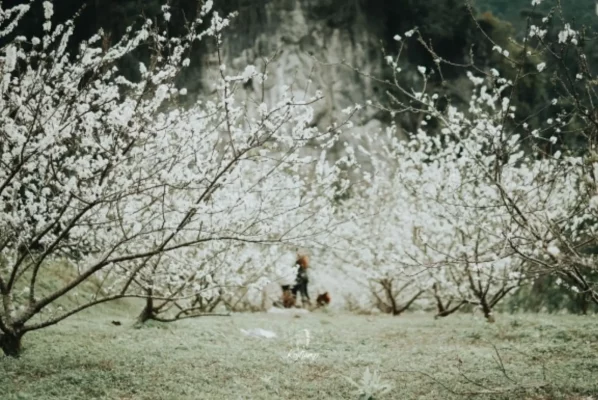
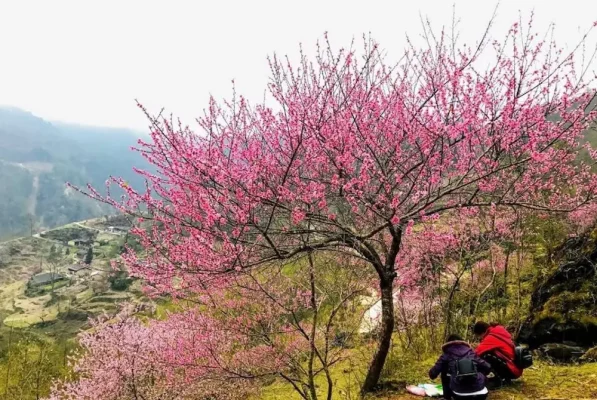
The landscape becomes fresher as vegetation returns, while peach, plum and other seasonal flowers may appear in different areas. Conditions are usually more comfortable for spending several hours outdoors each day.
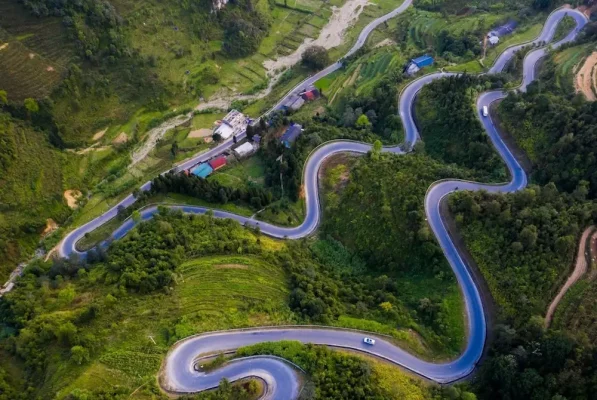
Good weather does not remove the challenges of the route. Ha Giang Loop still includes steep gradients, narrow roads, sharp bends and sections with limited visibility.
Travellers without mountain-riding experience should choose an Easy Rider instead of controlling a motorbike independently. A three-day tour covers the main highlights, while a four-day itinerary provides more time for viewpoints, villages and rest stops.
Late September to November: rice and flower seasons
This is often the most popular answer for travellers searching for the best time to visit Ha Giang Vietnam.
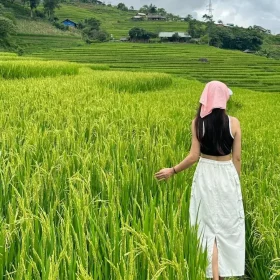
From late September through October, rice fields in many mountain areas gradually change from green to yellow. The exact harvest period varies according to altitude, village and planting schedule.
Travellers visiting specifically for golden rice should contact their accommodation or guide shortly before departure. Recent local updates are more reliable than fixed annual harvest dates.
October often provides the strongest balance of scenery, temperature and travel conditions. It is also a peak period, particularly over weekends. Experienced Easy Riders, small-group departures and private rooms can be booked quickly.
November is suitable for travellers who enjoy cooler weather and late-autumn scenery. Buckwheat flowers may appear across selected parts of the province, although flowering dates depend on weather and local planting schedules.
During this period, book tours, accommodation and transfers from Hanoi early. Advance booking provides more choices in group size, room category and driver arrangements.
May to August: green, dramatic and unpredictable
Summer transforms Ha Giang into a landscape of deep green mountains, young rice fields, low clouds and stronger waterfalls. It can be visually rewarding for travellers who enjoy dramatic weather and vibrant natural scenery.
Rain can make roads slippery, reduce visibility and cause planned routes to change. Some sections may become temporarily difficult because of flooding, falling rocks or landslide warnings.

If you travel during summer, prioritise a private or small-group tour, a four-day itinerary and a clear policy for weather-related route changes. Avoid operators that promise to complete every stop regardless of conditions.
A spare day can also be valuable. It prevents travellers from feeling pressured to continue when visibility or road conditions are unsuitable.
December to February: quiet roads and winter fog
Winter suits travellers who prefer quiet roads, fewer groups and mist-covered mountains. However, low temperatures, high humidity and reduced visibility can make the journey more demanding.
Pack thermal layers, a windproof jacket, gloves, waterproof clothing and closed shoes. A private tour or private car may be more comfortable because departure times can be adjusted according to fog and temperature.
Motorbike passengers should prepare for wind chill during long riding periods. Even when the forecast does not appear extremely cold, wind and moisture can make the temperature feel considerably lower.
How to Choose the Best Ha Giang Loop Tours
Weather determines what you may see, but tour quality determines how you experience it. The best Ha Giang Loop tours are not necessarily the cheapest or fastest options.
The right tour should match your available time, riding experience, preferred pace, accommodation expectations and comfort level.
| Tour type | Best for | Main advantages | Limitations |
| Three-day Easy Rider tour | Travellers with limited time | Affordable and covers major highlights | Longer daily riding distances |
| Four-day Easy Rider tour | First-time visitors | Slower pace and more stops | Higher price than a three-day tour |
| Private Easy Rider tour | Couples and families | Flexible schedule and personalised pace | Higher cost than a shared tour |
| Self-driving tour | Experienced and properly licensed riders | Greater independence | Higher risk and personal responsibility |
| Private car tour | Families and non-riders | Comfortable in cold or wet weather | Less open-air road experience |
| Loop and trekking combination | Travellers with six or seven days | More varied scenery and activities | Requires additional transfers and planning |
Should you choose a three-day or four-day tour?
A three-day, two-night tour is suitable when your schedule is limited. It still covers the principal attractions, but each day generally involves longer periods on the road.
A four-day, three-night tour is usually more comfortable for first-time visitors. Shorter daily distances create more time for photography, village visits and rest.
Choose a three-day tour when:
- Your Vietnam itinerary is already fixed.
- You are comfortable with long travel days.
- You mainly want to visit the best-known highlights.
- The weather forecast appears relatively stable.
- Your budget is limited.
Choose a four-day tour when:
- This is your first mountain motorbike journey.
- You prefer slow travel and frequent photography stops.
- You are visiting during the rainy or transitional season.
- You want more time in Dong Van, Meo Vac, Du Gia or smaller villages.
- Comfort is more important than finding the lowest price.
When comparing tour prices, check whether transfers from Hanoi, meals, private rooms, entrance fees and a Nho Que River boat trip are included. A lower advertised price may not represent a lower total cost.
Easy Rider or self-driving?
An Easy Rider is a local driver who controls the motorbike while the guest sits behind. This is a practical option for travellers who want an open-air mountain experience without personally navigating steep roads and sharp bends.
Self-driving provides greater freedom but requires relevant skills, valid documents and suitable insurance. Ha Giang Loop should not be treated as a place to learn how to ride a motorbike for the first time.
Before choosing self-drive, confirm:
- Which driving documents are required.
- Whether your insurance covers motorbike travel.
- Which motorbike type and engine capacity are provided.
- Whether helmets and protective equipment are included.
- How the itinerary changes during dangerous weather.
- What technical or emergency support is available.
- Whether you can switch to an Easy Rider if necessary.
Do not self-drive after drinking alcohol, when sleep-deprived or during heavy rain. Group pressure should never determine your riding speed.
Group tour or private tour?
Group tours are popular with solo travellers who want to reduce costs and meet new people. The experience is usually more enjoyable when the group remains small and the operator controls the pace responsibly.
Ask how many guests and motorbikes will travel together. A tour advertised as a small group may still join a much larger convoy during busy periods.
Private tours are better suited to couples, families, older travellers and guests who prefer higher accommodation standards. They also allow more control over departure times, photography stops, meals and daily travel distance.
The price is higher, but the additional flexibility can significantly improve the overall experience.
How to Use Ha Giang Loop Tour Reviews Before Booking
Reading recent Ha Giang Loop tour reviews is one of the most important steps before making a deposit. Do not rely only on the average star rating or promotional photographs.
Look for detailed, recent reviews that discuss driver behaviour, group size, equipment, accommodation and communication. Repeated comments are more useful than a single isolated complaint.
Pay attention to reviews mentioning:
- Safe, patient and responsible driving.
- The actual number of bikes in each group.
- The quality and fit of helmets.
- How the operator responds to rain, fog or road closures.
- Unexpected room changes or extra charges.
- Whether alcohol is kept separate from riding hours.
- The guide’s communication and language skills.
- Mechanical support and emergency procedures.
A review that only says the scenery was beautiful does not fully demonstrate tour quality. Strong reviews should also describe professional drivers, well-maintained equipment and responsible decisions during difficult conditions.
Questions to ask before paying a deposit
Before booking, ask the operator the following questions:
- What is the maximum group size? Smaller groups generally provide a more flexible and comfortable experience.
- How experienced are the Easy Riders? Ask whether the same driver will accompany you throughout the journey.
- What safety equipment is provided? Confirm helmet quality, rainwear and vehicle inspections.
- What happens during bad weather? Ask whether the tour may be delayed, shortened or redirected.
- Which accommodation is included? Confirm whether the price includes a private or shared room.
- Which costs are excluded? Check meals, entrance fees, transfers and optional activities.
- What is the cancellation policy? Understand the rules for changing dates, cancelling or postponing because of weather.
A professional operator should answer these questions clearly before requesting full payment.
Combine Ha Giang Loop with Panhou Retreat in Hoang Su Phi
Completing Ha Giang Loop does not have to mark the end of your northern Vietnam journey.
The traditional Loop is known for limestone plateaus, deep valleys and dramatic mountain passes. Hoang Su Phi offers a different environment shaped by terraced rice fields, forests, tea hills and trekking routes through local villages.
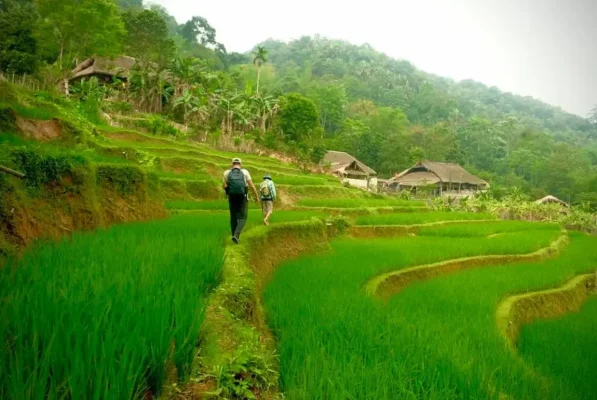
Hoang Su Phi is not directly included in the classic Ha Giang Loop. It should be planned as a separate destination instead of a brief roadside stop.
Travellers should ideally allow around seven days for a balanced combination. When time is limited, spend at least two nights in Hoang Su Phi.
| Ha Giang Loop | Hoang Su Phi and Panhou Retreat |
| Limestone plateaus and mountain passes | Rice terraces, forests and streams |
| Motorbike or car journey | Trekking and village walks |
| Frequent movement between destinations | Slower stay with time to recover |
| Road-based adventure | Nature, culture and wellness |
One possible route is:
Hanoi – Hoang Su Phi – Ha Giang City – Ha Giang Loop – Hanoi
This direction suits travellers who want to begin with trekking and spend time in nature before starting the mountain-road journey.
The opposite direction is also possible:
Hanoi – Ha Giang Loop – Hoang Su Phi – Hanoi
After three or four days on the road, travellers can slow down at Panhou Retreat, walk through terraced landscapes and explore Red Dao culture.
Panhou Retreat provides a peaceful base for discovering Hoang Su Phi through guided trekking, local cuisine and nature-based experiences. It also offers travellers time to rest after several demanding days on the Loop.
Contact Panhou Retreat for personalised advice on accommodation, trekking and transfers based on your travel dates.
FAQ
1. When is the best time to go to Ha Giang?
The most recommended periods are March to April and late September to November.
March and April offer comfortable spring weather, fresh vegetation and seasonal flowers. Late September and October are attractive for ripening rice, cooler temperatures and wider mountain views.
November is colder but may coincide with the buckwheat flower season.
2. When should I visit Ha Giang Province?
Visit in March or April if you prefer mild spring weather. Choose late September or October for rice landscapes and autumn scenery.
May and June are suitable for water-filled terraces, green rice and stronger waterfalls. July and August can be beautiful but require more flexibility because of rain.
December through February suits travellers who accept cold weather and frequent fog.
3. What is the best month to do Ha Giang Loop?
October is often considered the most balanced month for temperature, scenery and road conditions. However, it is also one of the busiest periods, so small-group tours and private Easy Riders should be booked early.
4. When should you avoid Ha Giang Loop?
No month is automatically impossible, but July and August generally require greater caution because of heavy rain, slippery roads and landslide risk.
Avoid travelling during severe-weather warnings, flash-flood alerts, road closures or periods of extremely low visibility.
5. Is September a good time for Ha Giang Loop?
Yes, particularly during the second half of the month. Early September may still receive summer rainfall, while conditions often become more stable later in the month.
6. Is November a good time for Ha Giang Loop?
November is a strong choice for cooler weather, potentially drier roads and seasonal flowers. Mornings and evenings can be cold, so pack windproof clothing and gloves.
7. How many days do you need for Ha Giang Loop?
Three days are sufficient to complete the main route, but four days generally provide a better experience. A four-day journey allows shorter daily distances, more stops and greater flexibility.
8. Is a three-day or four-day Ha Giang Loop tour better?
Choose three days when your schedule and budget are limited. Choose four days when you prioritise comfort, photography, village visits and a slower pace.
9. Should beginners self-drive Ha Giang Loop?
Beginners should usually choose an Easy Rider or private car. Self-driving is suitable only for travellers with relevant experience, valid documents and appropriate insurance.
10. Can I combine Ha Giang Loop with Hoang Su Phi?
Yes. Around seven days creates a balanced itinerary, while five days is possible with a faster schedule. Spend at least two nights in Hoang Su Phi to allow time for trekking and rest.

3D2N NATIONAL DAY OFFER | JOURNEY INTO GREEN SEASON
From 125 USD/Guest/Combo
3D2N GOLDEN SEASON IN HOANG SU PHI
From 114 USD/Guest/Combo