Bamboo Dance Origin: Why This Highland Ritual Was Born Among the Red Dao
| ExperiencesBamboo dance origin traces back to the Red Dao people of northern Vietnam, where the tradition is closely tied to the legend of Ban Vuong, the ancestral figure at the heart of Dao culture. Today, this living heritage remains vibrant in Hoang Su Phi, Ha Giang, where generations continue to preserve its rituals, meanings, and communal spirit.
Where does Bamboo Dance come from?
The question of bamboo dance origin often gets a simple answer: Southeast Asia. That is geographically correct but culturally incomplete. Bamboo dances exist across the region — from the Philippines to Myanmar — yet each carries its own distinct ancestry, meaning, and ritual context.
In Vietnam, the bamboo dance tradition most deeply rooted in ceremonial life belongs to the Red Dao people (Dao Đỏ) of the northern highlands. Their version of the dance did not develop as entertainment. It emerged from a worldview in which bamboo, rhythm, and collective movement were woven into the fabric of community survival and spiritual practice.
Understanding bamboo dance origin in Vietnam means understanding who the Red Dao are, and the founding legend that shaped everything about their culture.
The Legend of Ban Vuong: The root of Red Dao culture
Who was Ban Vuong?
At the heart of Red Dao cultural identity is the legend of Ban Vuong (Bàn Vương) – known in older records as Bàn Hồ (Panhou). According to the oral tradition passed down across all twelve branches of the Dao people, Ban Vuong was a courageous and wise being who helped bring peace to a war-torn kingdom. In reward, he was given land and a royal bride, becoming the founding ancestor of the Dao lineage.
Ban Vuong fathered twelve children. Each was given a different family name and from these twelve children descended the twelve branches of the Red Dao people alive today. For the Dao, this is not merely mythology. The Cap Sac coming-of-age ceremony, one of the most sacred rites in Dao culture — includes rituals that directly honour Ban Vuong and re-enact aspects of this founding story.
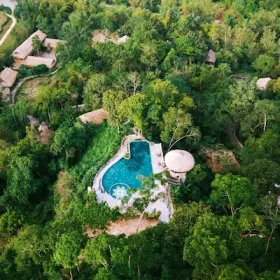
The resort Panhou Retreat takes its name directly from Bàn Hồ, Ban Vuong’s original name. Situated in Hoang Su Phi, one of the most significant Red Dao settlements in Vietnam, the resort’s identity is consciously rooted in this same ancestral narrative.
How Bamboo Dance connects to this founding legend
The bamboo dance origin is inseparable from Ban Vuong’s story. Red Dao oral tradition describes Ban Vuong as someone who moved between worlds, between the realm of kings and the realm of nature, between strength and simplicity. Bamboo, in this context, becomes a physical metaphor for that passage.
The basic movement of bamboo dance, stepping through poles that open and close, mirrors this idea of navigating between states. The dancer must be present, precise, and in harmony with the rhythm set by others. No one can dominate the dance alone. This is understood, in Red Dao tradition, as a re-enactment of the balance that Ban Vuong himself embodied.
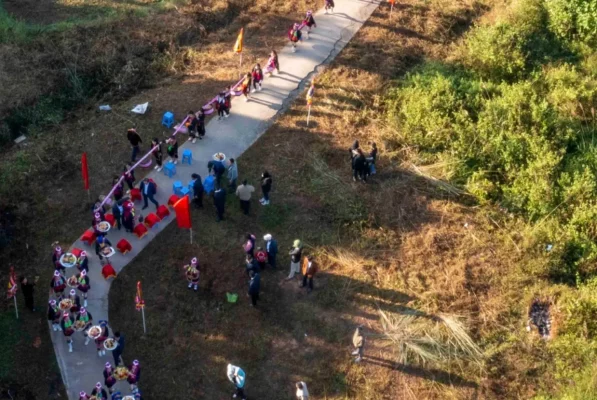
Ceremonies honouring Ban Vuong traditionally include music, collective movement, and bamboo instruments. Over generations, these elements coalesced into what is now recognized as bamboo dance – a form that carries the ancestor’s spirit in its structure.
How Bamboo Dance evolved through generations
From Ceremony to cultural expression
In its earliest forms, the Red Dao bamboo dance was strictly ceremonial, performed only at specific moments in the ritual calendar. The most significant occasions included:
- The Ban Vuong Ancestor Ceremony: held on the 16th day of the first lunar month, this is the most sacred collective ritual in Red Dao life. Bamboo dance forms part of the communal celebration that follows the formal ceremony
- Cap Sac: the rite of passage that marks a young Red Dao man’s transition to adulthood. Bamboo dance may accompany the communal feast after the formal rituals
- Harvest festivals: celebrated in September and October as the rice terraces turn golden, these village-wide events traditionally include music and dance
Over time, as Red Dao communities became more settled and as inter-village connections strengthened, bamboo dance gradually evolved into a form of cultural expression that extended beyond strictly sacred occasions. It became a way for communities to mark joy, to welcome guests, and to teach younger generations about identity and belonging.
The role of Bamboo in Red Dao material culture
Bamboo dance origin cannot be understood without appreciating bamboo’s role in Red Dao daily life. In highland communities, bamboo serves as:
- Structural material for homes, fences, and bridges
- The source of musical instruments – flutes, percussion, and resonant tubes used in ceremony
- A marker of village boundaries, where dense bamboo groves signal the edge of settled land
- A food source, with bamboo shoots as a staple ingredient in highland cuisine
When bamboo is used in dance, it carries all of these associations simultaneously. The poles are not props, they are an extension of the landscape the Red Dao have inhabited and shaped for centuries.
Source: Institute for Cultural Studies, Vietnam Academy of Social Sciences
Bamboo dance origin alive today at Panhou Retreat
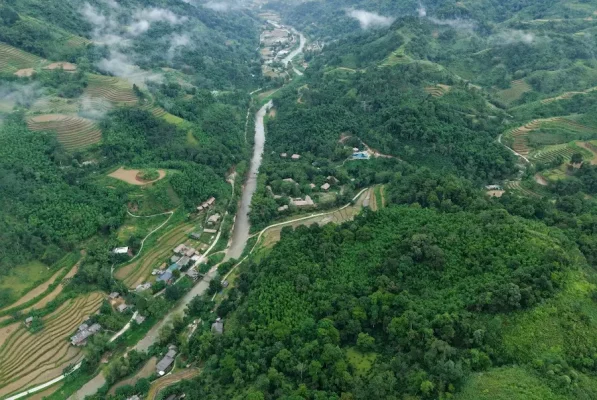
The bamboo dance origin story is not confined to history books. In Hoang Su Phi, where Red Dao villages still practice ancestral ceremonies, where the Ban Vuong legend is recited to children, and where bamboo groves still frame the edges of highland hamlets, this tradition remains a living inheritance.
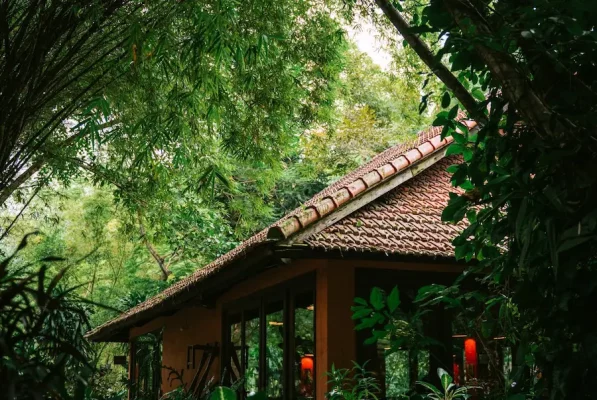
Panhou Retreat was built within this landscape twenty years ago. The resort’s name honours Ban Vuong’s original name. Its staff are drawn overwhelmingly from local Red Dao and neighbouring ethnic communities. Its cultural programs are designed to connect guests with real village life, not recreated folklore, but the actual rhythms and ceremonies of people who have carried this tradition for centuries.
When Panhou guests participate in trekking programs that lead to Red Dao communities, they enter the same landscape where bamboo dance origin took root. The experience is not curated for tourist comfort. It is offered with the understanding that cultural continuity depends on genuine engagement.
Panhou’s founding philosophy – “Mingle Nature & Legend”, is itself an echo of bamboo dance’s deepest meaning: that the boundary between the natural world and the world of human story is not a wall, but a rhythm to be stepped through with care.
Bamboo dance origin is ultimately a story about people who refused to let their history dissolve into silence — who encoded it into movement, rhythm, and the hollow note of a bamboo pole striking the earth. At Panhou Retreat in Hoang Su Phi, that story is still being told in every step between the poles.
FAQ
1. Which culture originated the bamboo dance?
In Vietnam, bamboo dance origin is most directly linked to the Red Dao ethnic people of the northern highlands. While bamboo dances exist across Southeast Asia, each carries distinct ancestry — the Red Dao version is rooted in ceremonial traditions tied to the Ban Vuong founding legend.
2. Is bamboo dance found only in Vietnam?
No — similar bamboo dances appear across Southeast Asia, including the Filipino Tinikling and variations in Myanmar, Laos, and Indonesia. However, each tradition carries its own cultural roots and spiritual meaning specific to its people of origin.
3. How old is the bamboo dance tradition among the Red Dao?
Precise dating is difficult since the tradition was transmitted orally across generations. Most ethnographic accounts trace active bamboo dance practice in Red Dao communities back several centuries, closely tied to the Ban Vuong ancestor ceremonies that predate written records.
4. What does bamboo symbolise in the dance?
Bamboo represents resilience, communal rhythm, and the passage between realms — earthly and ancestral. In Red Dao culture, the movement between the clapping poles mirrors the balance that their founding ancestor Ban Vuong embodied: strength grounded in humility, courage inseparable from harmony.
5. Where can I learn about bamboo dance origin in person?
Hoang Su Phi, Ha Giang is the most immersive context. Panhou Retreat offers cultural programs that connect guests with Red Dao communities where this tradition originated and continues to be practised in its living form.

3D2N NATIONAL DAY OFFER | JOURNEY INTO GREEN SEASON
From 125 USD/Guest/Combo
3D2N GOLDEN SEASON IN HOANG SU PHI
From 114 USD/Guest/Combo